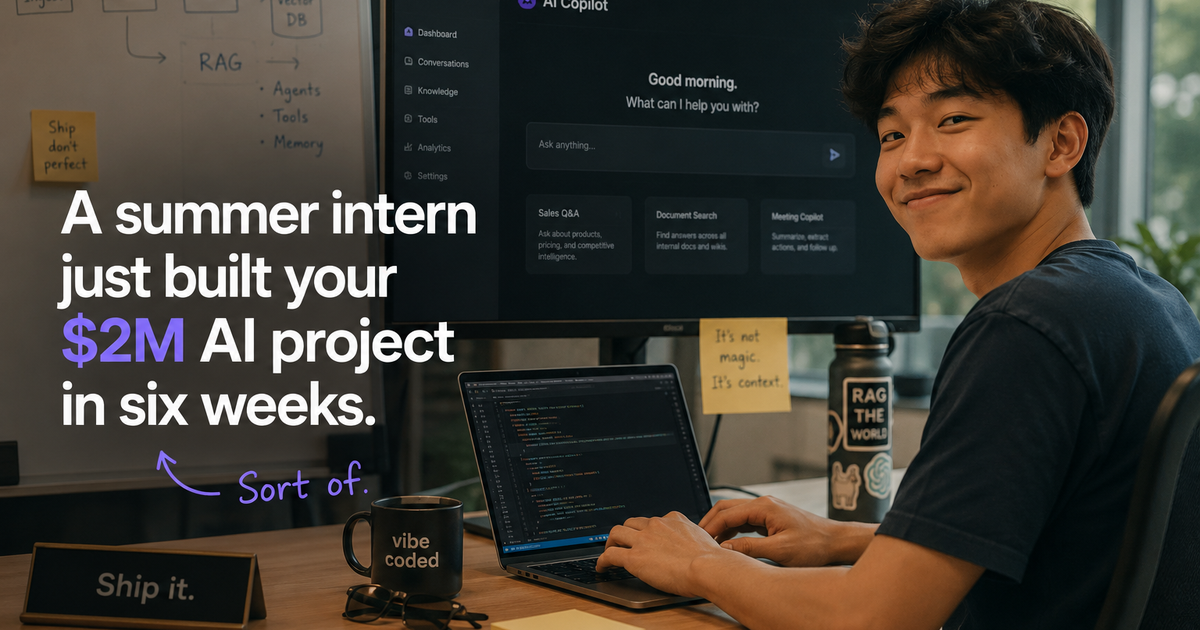
A summer intern just built your $2M AI project in six weeks. Sort of
I keep seeing versions of the same meeting.
An intern gets an AI assistant and eight weeks. In week six they demo something that works. Clean interface. Answers real questions about the business. The executive team lights up.
And then someone looks at the seven-figure AI transformation proposal on the table and asks the obvious question.
Here’s my honest take: *the line between those two things is thinner in a few places and much wider in most — and it got wider because of AI, not in spite of it.*
What genuinely collapsed:
Building the part you can see. Time to first working version. The cost of trying an idea. Any consultant claiming that still takes a quarter is protecting a business model.
What did not collapse:
Knowing whether it’s right. Your business isn’t the happy path — it’s the contract that gets treated differently, the customer segment that needs a manual hold, the eleven people who know the exceptions and never wrote them down. The demo produces a confident answer for those cases too. It’s just wrong. And the executives grading the demo are, structurally, the people least able to detect that.
Regular software fails loudly. AI fails plausibly.
Then there’s the part nobody demos.
To make the demo good, someone fed it real material. Real contracts. Real code. Real customer data.
Netskope’s 2026 report: source code is 42% of all enterprise AI data-policy violations. Average org logs 223 violation incidents a month, double last year.
IBM’s breach research: 63% of breached organizations either had no AI governance policy or were still writing one. 97% of those with an AI-related incident lacked proper AI access controls.
And the controls that would catch this? On most cloud AI platforms they are off by default. Not difficult. Off. Because nobody was assigned to turn them on — and a prototype is definitionally work nobody was assigned.
The math that explains all of it:
Old rule — the first 90% of a project takes 10% of the effort, the last 10% takes the other 90%.
AI ate the cheap part.
That doesn’t make the project smaller. It makes the hard part a bigger share of what’s left. The demo now arrives in week six and lands just as far from done — which makes the remaining distance more surprising, not less.
So what do you actually do?
Don’t cancel the intern’s project. It’s the cheapest requirements document you’ll ever get, and it proved internal demand better than any business case.
But stop using it as a price comparison. Instead, ask your vendor — and ask yourself:
→ How will we know when it’s wrong? → What happens downstream when it is? → Who can see what this costs, by team, this month? → What stops our IP from leaving the building? → Who owns this in year three, after the intern goes back to school?
If nobody can answer those, the problem isn’t the price tag. The problem is that you were about to buy the same demo twice.
Curious whether others are seeing this. Has an internal prototype blown up a vendor conversation at your company — and did it end well?
(Part two coming: why the middleware layer — the “AI in the middle” — is the thing that actually determines whether any of this survives contact with production.)
Let's talk about what you're building.
Our team brings over two decades of experience to every engagement. Tell us about your project and we'll show you what's possible.
Related

Twenty-Two Years, Including the Parts That Didn’t Work
Why trust EFS with your enterprise AI project? 22 years of pattern recognition, dual AWS AI Competency, Anthropic Claude Partner status, and Datum CMDB.

Utilizing AWS API Gateway and FAAS Serverless Tech for Kynectiv Report Generation
How EFS Networks used AWS API Gateway, Lambda, and S3 to offload PDF report generation for Kynectiv, reducing server load with serverless architecture.
Kynectiv Takes Engagement and Professional Training to a New Level with Simulations
How EFS Networks rebuilt Kynectiv's simulation application from prototype to scalable SaaS on AWS, delivering enterprise training solutions for medical and education industries.